Compartir
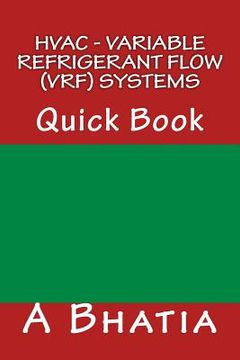
Hvac - Variable Refrigerant Flow (Vrf) Systems: Quick Book (en Inglés)
A. Bhatia
(Autor)
·
Createspace
· Tapa Blanda
Hvac - Variable Refrigerant Flow (Vrf) Systems: Quick Book (en Inglés) - Bhatia, A.
Libro Nuevo
Importado
Envío: 20 a 26 días háb.
$ 3.888$ 1.944
Costos de importación incluídos en el precio ✅
Reseña del libro "Hvac - Variable Refrigerant Flow (Vrf) Systems: Quick Book (en Inglés)"
VRF (Variable refrigerant flow) is an air-condition system configuration where there is one outdoor condensing unit and multiple indoor units. The term variable refrigerant flow (VRF) refers to the ability of the system to control the amount of refrigerant flowing to the multiple evaporators (indoor units), enabling the use of many evaporators of differing capacities and configurations connected to single condensing unit. The arrangement provides an individualized comfort control, and simultaneous heating and cooling in different zones. Currently widely applied in large buildings especially in Japan and Europe, these systems are just starting to be introduced in the U.S. The VRF technology/system was developed and designed by Daikin Industries, Japan who named and protected the term variable refrigerant volume (VRV) system so other manufacturers use the term VRF "variable refrigerant flow". In essence both are same. With a higher efficiency and increased controllability, the VRF system can help achieve a sustainable design. Unfortunately, the design of VRF systems is more complicated and requires additional work compared to designing a conventional direct expansion (DX) system. This 3 -hour quick book provides an overview of VRF system technology. Emphasis is placed on the control principles, terminology, basic components, advantages and design limitations. This course is aimed at the personnel who have some limited background in the air conditioning field and is suitable for mechanical, electrical, controls and HVAC engineers, architects, building designers, contractors, estimators, energy auditors and facility managers. The course includes a multiple-choice quiz consisting of fifteen (15) questions at the end. Learning Objective At the conclusion of this course, the reader will: -Understand the difference between multi-split air conditioning system and VRF systems; -Understand the operating principle of direct expansion split and VRF system; -Understand the concept of thermal zone; -Understand how VRF with heat recovery are different from ordinary heat pump systems; -Understand the operation of thermostatic expansion valve (TXV) and electronic expansion valve (EEV); -Understand the influence of building characteristics and load profile on selection of VRF system; -Learn the advantages and application of VRF systems; -Understand the design limitations and challenges in design of VRF systems.
- 0% (0)
- 0% (0)
- 0% (0)
- 0% (0)
- 0% (0)
Todos los libros de nuestro catálogo son Originales.
El libro está escrito en Inglés.
La encuadernación de esta edición es Tapa Blanda.
✓ Producto agregado correctamente al carro, Ir a Pagar.