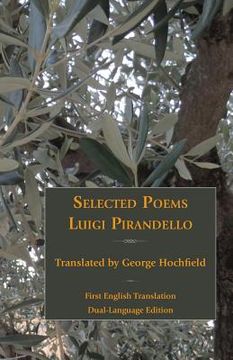
Reseña del libro "Selected Poems of Luigi Pirandello (en Inglés)"
Luigi Pirandello, an author best know for his plays, novels and short stories, was also a life-long poet. At the age of twenty-two, he published his first collection, "Mal giocondo" (1889, Troubled Joy), followed quickly by three further volumes, "Pasqua in Gea" (1891, Easter in Gea), "Elegie renane" (1895, Rhenish Elegies) and "Zampogna" (1901, Bagpipes). In 1912 he published his final volume of poetry, "Fuori di chiave" (Offkey), but he continued to publish poetry in literary journals and anthologies until his death in 1936. In a literary career that spans the turning of the twentieth century, his poetry reflected many of the currents of his time: modernism and relativism, the tension between faith and science and the place of the individual in a world devoid of coherence. He writes movingly of nature -- silent, indifferent, unconscious, enduring -- as the very antithesis of chaotic human activity. He writes of life and death, children and coffee, of love, earth and dreams. His style might seem traditional -- more traditional than would be expected of an author whose work for theater surpassed mere innovation -- and while his forms might be conservative, his ideas matched the spirit of his age. As the translator George Hochfield writes in his introduction, "These poems reveal a somber and sensitive man, the dramatist, who, when the play is over and the curtain is drawn, comes to the front of the stage and addresses the audience directly." This dual-language edition presents for the first time in English translation a selection of work from the entire range of Pirandello's poetic output. George Hochfield offers a sensitive and wise interpretation of that poetry. Appendices include a selection from "Arte e coscienza d'oggi" (1893, Art and Consciousness in Our Time) and from Pirandello's Biographical Letter of 1914. Dual-language Poetry Introduction, bibliography, chronology, first-line indices, notes and appendices. 256 pages.
Luigi Pirandello nació en el seno de una familia acomodada. Cursó sus estudios superiores en Palermo, Roma y Bonn. Volvió luego a Italia para ejercer de profesor de Literatura en la Escuela Normal Femenina de Roma, puesto que dejaría cuando su creciente reputación le permitió dedicarse en exclusiva a su carrera como escritor. Pirandello comenzó escribiendo poesía y relatos cortos, pero es fundamentalmente conocido por su faceta como dramaturgo.
En sus obras volcó todas sus ideas filosóficas y se permitió explorar la psicología humana por medio de personajes populares en un novedoso lenguaje teatral que dejaba atrás las convenciones tradicionales. Ya como autor reconocido, fue nombrado director del Teatro d’Arte de Roma en 1925 y miembro de la Real Academia de Italia en 1929.
En 1934 recibió el Premio Nobel de Literatura por su «audaz e ingeniosa renovación del arte dramático y escénico». Aunque la figura de Pirandello quedó ligeramente empañada por sus lazos con el fascismo de Mussolini, su brillante trayectoria lo sitúa como el más importante dramaturgo de la Europa de entreguerras y uno de los grandes innovadores del teatro del siglo xx, cuya visión vanguardista sigue estando vigente hoy en día.
Ver más
Ver menos